
English
Reading at BFHA
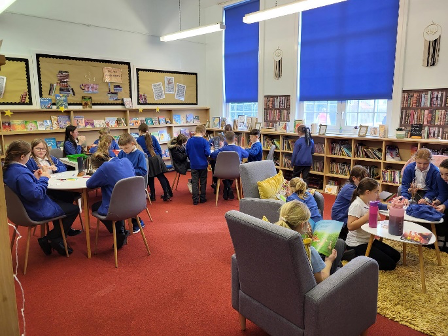
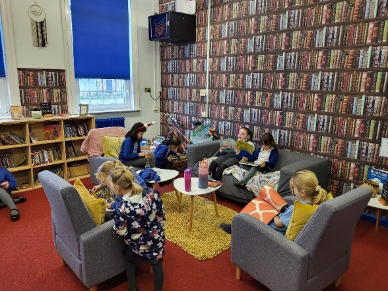
At Bilsthorpe Flying High Academy, reading underpins everything we do. Through teaching a rich curriculum, we continuously expose our children to a broad range of high-quality texts. Here at Bilsthorpe Flying High Academy, we create lifelong readers, who enjoy reading and choose to read.
Every day, our children receive a reading lesson that focuses on firstly, teaching the skills of reading, through our synthetic phonics programme – No Nonsense Phonics (decoding, encoding, blending) and then, moving on to developing comprehension, prediction, inference and the understanding of vocabulary.
We strongly promote reading for pleasure and offer children the opportunities to share books and talk about what they have read. We have close links with our local village library and regular visits there ensure our children have the opportunity to choose and peruse the books they enjoy reading. We run a number of initiatives in school that promote reading. Our children receive a half termly reward if they climb all the way up our reading ladders, which are in every classroom and puts the onus on the children to read in their spare time. Each class has a designated story time at the end of each day, and the children have input into which stories are shared.
Writing at BFHA
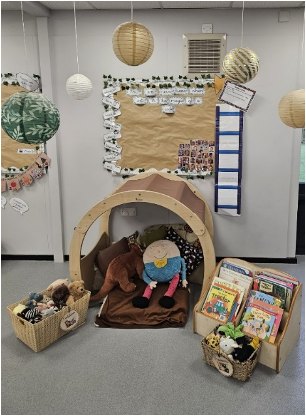
At Bilsthorpe Flying High Academy, we teach writing daily. We look for creative ways to engage our writers, and we closely link all our writing to other areas of the curriculum to make it purposeful and meaningful for our children.
Our children receive a daily English lesson, where writing is taught. We follow a three-week structure to our writing units, across the school.
|
Week 1 |
|
|
Week 2 |
|
|
Week 3 |
|
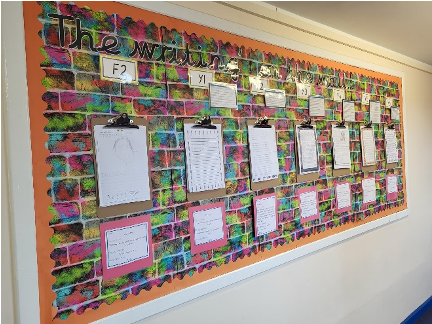
We use high quality texts to bring the units to life. The units are carefully planned across both the year group and the school. This is to ensure that our children can build upon and further develop their previous learning, enabling them to leave our school being able to craft a variety of different pieces. At the end of each unit, the children’s work is displayed on our writing wall. This allows the children to see their work being published, as well as see the progression of writing throughout school.
We create opportunities to write across other areas of the curriculum, as this allows the children to demonstrate their knowledge and understanding of other areas of the curriculum.
Spelling at BFHA
-
We cover all spelling aspects of the National Curriculum by using a rigorous spelling approach called Support for Spelling. Click here to learn more about the approach.
-
We believe our pupils should be able to spell with confidence and have the strategies to apply new spellings into their writing. If they are unable to spell a word, we also believe they need to have the strategies to deal with this, so it does not affect the flow of their writing.
-
Our approach to teaching spelling allows pupils to investigate words to help build patterns of knowledge. This exploration is supplemented by specific lessons that teach children how to learn new spellings.
-
Our approach enables teachers to build sequences of learning that meet the needs of our pupils. Teachers are able to direct teach new content as well as work alongside them during exploration opportunities.
-
Lessons follow a consistent structure and sequence of learning so there is a sense of familiarity for our pupils. The working walls also support children during and beyond their spelling lessons.
-
Our staff have accessed high-quality training so they are able to deliver spelling lessons with confidence. Materials are also provided so that they have access to the very best guidance and knowledge for each spelling unit.
-
Our pupils cover 6 units per team and each unit lasts for two week. In that period they access four spelling lessons. Details of the new learning in each unit can be found below. Each unit also allows pupils to return to a previous unit so they are able to reactivate prior learning.
-
In addition to the units, we also use something called the essential extras. For example, our children have spelling journals to support them to apply new spellings in their writing.
Support for spelling overview:
|
|
Unit 1 |
Unit 2 |
Unit 3 |
Unit 4 |
Unit 5 |
Unit 6 |
|
Year 2 |
(The /n/ sound spelt as kn and gn at the beginning of words. (6 ways=n, nn, kn, gn, -ne, pn)
|
(The /r/ spelt wr at the beginning of words.)
|
(The /igh/ spelt as -y)
|
(Adding -es to words ending in -y)
|
Adding -ed, -ing, -er and -est to a root words ending in -y with a consonant before it.
|
We ensure all children are secure with the Y1 common exception words.
We also spend time on subject specific (tier 3) words where there were misconceptions.
|
|
Year 3 |
(‘mis-‘ and ‘re-‘ prefixes)
|
(Y2 review ‘-ness’ and ‘-ful following a consonant suffixes.)
|
(‘sub-‘ prefixe)
|
(‘-ly’ suffix)
|
(/sh/ phoneme as ch (French), and /k/ phoneme as ch (Greek).)
|
(‘-less’ suffix)
|
|
Year 4 |
(The /u/ spelt as ou. As in touch)
|
(Words endings sounding like /c//uh/. It is often spelt as -ture, but check that the word is not a root word ending in (t)ch with an er ending. As in teacher, richer, catcher.)
|
(Possessive apostrophes with plurals.)
|
(Prefix ant- means ‘against.’)
|
(Endings -tion, -sion, -ssion and -cian.)
|
We consolidate Year 4 word list words taught so far. Focus on words that are not applied correctly. . |
|
Year 5 |
(Words ending in -ably and -ibly.)
|
(Homophones and other words that are often confused.)
|
(Words with the /i:/ sound spelt ei after c)
|
(Endings -cial and -tial.)
|
(-able, -ible, -ably, -ibly, -cial, -tial suffixes)
|
We consolidate Year 5 word list words taught so far. Focus on words that are not applied correctly.
|
|
Year 6 |
Unit 1 Adding -ly
|
Unit 2 Adding suffixes beginning with vowel letters to words of more than one syllable. E.g. ed, ing..
|
Unit 3 Suffix-ous
|
Unit 4 Suffix -ation
|
Unit 5 -ible/-able, -ibly/-ably
|
Unit 6 Suffixes -ant, -ance, -ancy, -ent, -ence and -ency.
|